From engineering and data science to marketing and product development, Quensus is helping the next generation of professionals gain valuable industry experience by contributing to real-world projects.
At Quensus, innovation has always been central to what we do. From developing intelligent water leak detection technology to helping businesses better understand and manage water consumption, our continued growth depends on combining technical expertise, fresh thinking and a willingness to challenge conventional approaches.
But innovation is not just about the technology we develop. It is also about the people behind it.
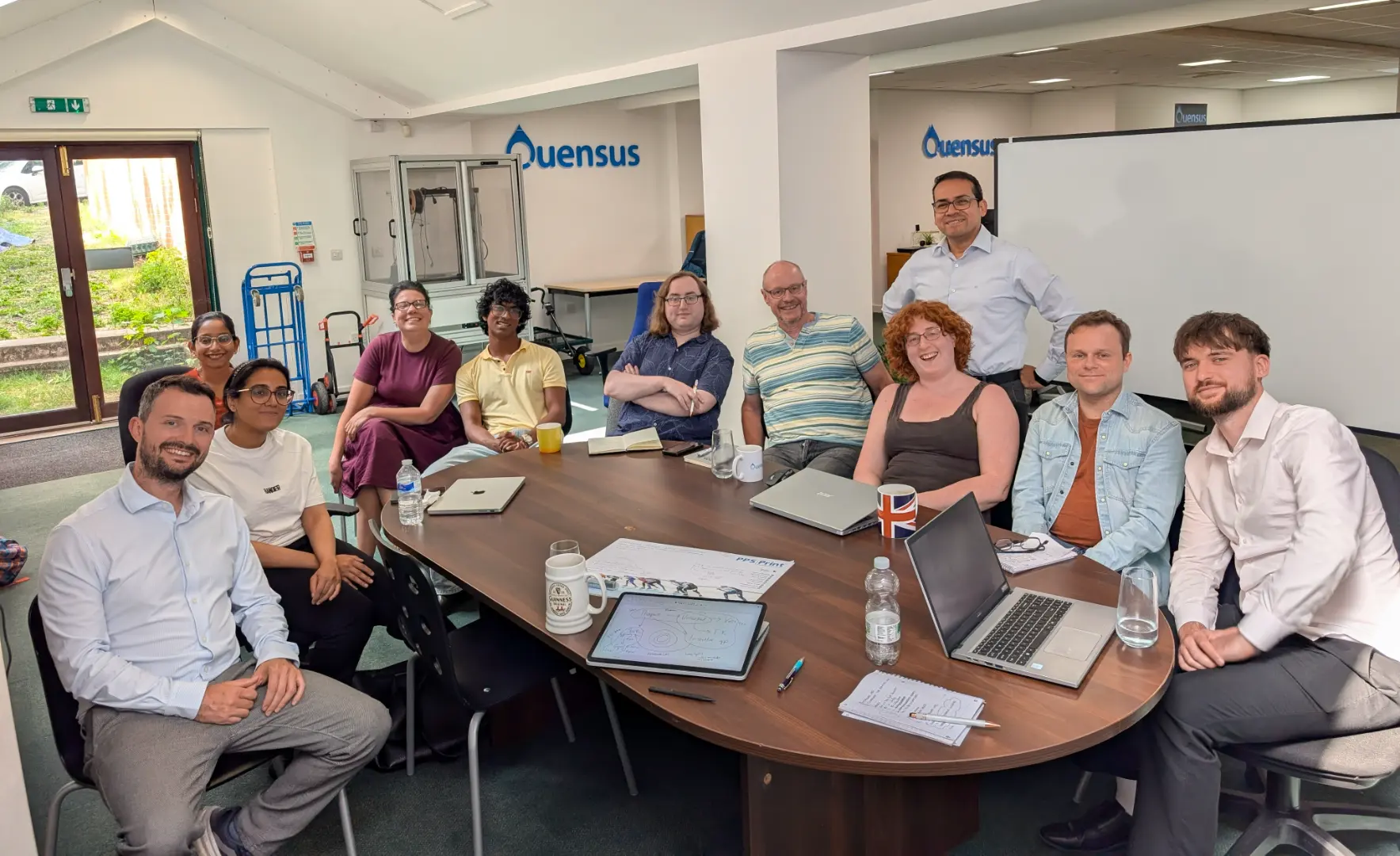
Over recent months, we have had the pleasure of welcoming a talented group of students and graduates from universities and schools across the UK, providing opportunities to gain practical experience while making meaningful contributions to our business.
Working across engineering, software development, data science, marketing and commercial strategy, each individual has brought their own knowledge, perspective and enthusiasm to the team.
For us, this represents something much more valuable than a traditional placement programme. It is an opportunity to invest in emerging talent while giving students a genuine understanding of how their skills can be applied within a growing technology business.
Learning Through Real-World Experience
There is a significant difference between studying a subject and applying that knowledge to a live commercial challenge.
Although academic learning provides an essential foundation, opportunities to work with real data, evolving technologies and genuine business requirements can be invaluable in developing professional skills.
At Quensus, we believe placements and work experience should involve more than observing from the sidelines.
Our approach is to involve students in meaningful projects that reflect the work being undertaken across the business. Rather than assigning purely theoretical exercises, we aim to provide opportunities to contribute to ongoing development, solve practical problems and explore ideas with real commercial relevance.
This means working alongside our team, gaining exposure to different departments and understanding how engineering, technology and business decisions connect.
The experience is equally valuable for Quensus. Bringing new people into the business introduces different perspectives, challenges established thinking and creates opportunities to explore new approaches.
Our latest cohort demonstrates just how diverse these contributions can be.
Engineering and Software: Supporting the Technology of Tomorrow
As Quensus continues developing its intelligent water management technology, engineering and software development remain fundamental to our operations.
Creating reliable, scalable solutions requires expertise across hardware, firmware, software infrastructure and product design.
Several members of our latest cohort have been directly involved in these areas, supporting projects connected to our existing technology and future product development.
Zuming Chang | University of Nottingham
Embedded Systems and LeakNet Gen3 Development
Zuming has been contributing to the development of LeakNet Gen3, the next generation of our intelligent water leak detection technology.
His work focuses on embedded systems, including porting location-based leak detection algorithms into C/C++ firmware and supporting hardware testing.
Embedded software plays a crucial role in how connected devices process information, respond to sensor inputs and perform reliably in practical environments.
Translating complex algorithms into firmware requires careful consideration of computational requirements, hardware limitations and system performance.
Through this project, Zuming is gaining experience at the intersection of software engineering and physical technology, while supporting the ongoing development and testing of our next-generation systems.
Louie Stadler | Newcastle University
Hardware Development, 3D Printing and Product Design
While software enables intelligent functionality, the physical design of a product is equally important.
Louie has been supporting our hardware development activities, using 3D printing and enclosure design to help transform engineering concepts into physical components.
His work involves exploring how digital designs can be translated into practical prototypes, providing opportunities to evaluate form, fit and physical design considerations.
This process is an important part of product development, allowing engineers to test ideas, refine components and assess designs before progressing further.
By contributing to these activities, Louie is gaining valuable experience in prototyping and the practical considerations involved in developing technology for real-world applications.
Vidhu Yashendra Silva | Loughborough University
Backend Software Development and Infrastructure
Behind every connected water management system is a software infrastructure responsible for supporting the flow, processing and accessibility of information.
Vidhu has been working directly within the Quensus software stack, contributing to backend development and infrastructure as we continue scaling the systems that support our technology.
This provides exposure to the practical challenges of building and maintaining software that must support connected devices, data processing and user-facing applications.
Working within an established development environment also offers valuable insight into how software components interact and how technical decisions influence the wider platform.
His contribution supports an important area of our continued development as we work to ensure our technology can meet evolving customer and operational requirements.
Data Science and Analytics: Turning Information into Insight
Water monitoring technology generates significant quantities of information, but collecting data is only part of the challenge.
Understanding what that information tells us, identifying meaningful patterns and presenting findings clearly are all essential to developing intelligent and effective solutions.
Data science and analytics therefore play an important role in both our technology development and our internal operations.
Two members of our cohort have been exploring these areas through distinct but complementary projects.
Yumna Noman | University of Nottingham
Sensor Data Analysis and Machine Learning
Yumna has been working with core sensor datasets, exploring how data analysis and statistical techniques can help us better understand water consumption patterns.
Her work includes cleaning and analysing complex building data, evaluating statistical thresholds and applying techniques such as K-Means clustering and time-series clustering.
These approaches can help identify similarities, group behaviours and explore patterns within large datasets that may not be immediately apparent through conventional analysis.
For a business specialising in intelligent water monitoring, understanding normal and abnormal consumption behaviour is particularly relevant.
Investigating these patterns provides useful insight into how data-led approaches can support the continued development of water monitoring and leak detection technology.
The project also gives Yumna experience working with real operational datasets, where data preparation, interpretation and the evaluation of analytical methods are just as important as the algorithms themselves.
Sutapa Biswas | University of Nottingham
Business Intelligence and Performance Dashboards
Data also plays an important role in how we manage and develop our business.
Sutapa has been working on KPI dashboards and live office displays that bring together information from our sales, marketing and operational activities.
The objective is to make important performance indicators more accessible, providing the team with clearer visibility of business activity and helping inform day-to-day decisions.
Developing effective dashboards requires more than simply displaying numbers. It involves understanding which metrics matter, how information should be structured and how complex data can be presented in a way that is useful to different teams.
Through this work, Sutapa is helping us explore better ways of communicating operational performance while gaining hands-on experience in business intelligence and data visualisation.
It is a practical example of how analytical skills can create value beyond a company's core technical products.
Marketing and Commercial Strategy: Bringing Innovation to Market
Developing innovative technology is only one part of building a successful business.
Equally important is understanding the market, communicating the value of a solution and creating effective strategies for reaching the people and organisations that can benefit from it.
As Quensus continues expanding its products, partnerships and operations, commercial development remains an important area of focus.
Our students working in marketing, PR and commercial strategy have been exploring challenges directly connected to these priorities.
Yusra Umar | University of Nottingham
Public Relations and Brand Strategy
Yusra has been supporting our PR and brand strategy activities, helping identify opportunities to strengthen Quensus' market presence and communicate our work to a wider audience.
Her project includes exploring thought leadership opportunities, considering how we position our expertise and identifying ways to build awareness of the Quensus brand.
For a technology company operating in a specialist industry, effective communication is essential.
It involves translating technical capabilities into clear messages that explain not just what a product does, but why it matters to customers, partners and the wider market.
Through this work, Yusra is gaining experience in strategic communications while contributing new ideas to how we tell the Quensus story.
Andrew Bayne | University of Nottingham
Installer Network Marketing and Growth
Andrew has been focusing on the development and growth of our Installer Network.
The Quensus Installer Network forms an important part of our wider strategy to support effective installation, technical standards and the adoption of intelligent water management technology.
Andrew's work involves exploring marketing and growth strategies designed to increase engagement across the installer ecosystem and encourage adoption of the Quensus platform.
This includes considering how we communicate the benefits of joining the network, strengthen relationships with installers and develop opportunities for continued engagement.
The project offers valuable exposure to business-to-business marketing, platform growth and the commercial considerations involved in building an effective partner network.
Hira Jalal | University of Nottingham
Product Go-to-Market Strategy
Hira has been contributing to the commercial planning behind upcoming Quensus products.
Her work focuses on developing go-to-market strategies, including researching potential target markets, exploring product positioning and evaluating routes to commercial adoption.
Launching a new technology product involves understanding far more than its technical specifications.
It requires a clear view of the problems it solves, the customers most likely to benefit, the competitive environment and the commercial channels through which it can reach the market.
By investigating these considerations, Hira is helping us explore how emerging technologies can be positioned for successful introduction.
The experience provides a practical understanding of how product development, marketing and commercial strategy come together to support business growth.
Introducing School Students to the World of Work
Our commitment to developing future talent extends beyond university students and graduates.
We have also welcomed Job Schofield from Grantham The King's School, alongside Ousman Cham and Mustafa Abbas from Nottingham University Samworth Academy, for an intensive five-day work experience programme.
The programme gave the students an opportunity to experience a working technology business, develop their understanding of different commercial activities and explore how their perspectives could contribute to real discussions.
An important part of their experience involved bringing a Generation Z perspective into the business.
As a generation growing up in an increasingly digital environment, younger students can offer interesting insights into how technology is perceived, how information is consumed and what influences engagement.
The students explored these perspectives and presented their findings directly to the Quensus team.
This gave them experience in researching ideas, organising their findings and communicating recommendations in a professional environment.
For Quensus, it was an opportunity to hear directly from a younger generation and consider viewpoints that might otherwise be overlooked in everyday business discussions.
Work experience programmes such as these can play an important role in helping students understand potential career paths, build confidence and recognise how the skills they develop in education translate into the workplace.
Looking Ahead: Developing New Approaches to Revenue Forecasting
Our work with emerging talent is continuing, with further projects already planned.
We are looking forward to welcoming Oliver Chen from the University of Bristol, who will be joining us to work on a probabilistic revenue forecasting model.
The project will explore how historical deal velocity and commercial data can be used to model potential business growth over the next 24 months.
Rather than relying solely on fixed assumptions, probabilistic forecasting can help businesses consider a range of potential outcomes and account for uncertainty within their projections.
The work will involve examining historical commercial patterns and exploring how this information can support more informed financial and strategic planning.
It represents another example of how specialist analytical skills can be applied to practical business challenges, offering Oliver experience with real commercial information while supporting our approach to forecasting and decision-making.
Why Investing in Emerging Talent Matters
For Quensus, supporting students and graduates is not simply about providing short-term work experience.
It forms part of our wider commitment to developing talent, encouraging innovation and building the skills needed to support the future of engineering and technology.
The challenges facing industries such as construction, property management and water infrastructure continue to evolve.
Addressing these challenges requires people who can combine technical understanding with creativity, analytical thinking and practical problem-solving.
Providing opportunities to work on genuine projects helps emerging professionals develop these capabilities in ways that classroom learning alone cannot always replicate.
It also gives them greater exposure to the realities of professional collaboration, including understanding business requirements, communicating with colleagues, responding to feedback and adapting ideas as projects develop.
From our perspective, there are equally important benefits.
Students and graduates bring curiosity, enthusiasm and a willingness to explore different approaches. Their contributions can challenge assumptions, generate new ideas and help us look at familiar problems from a different angle.
The breadth of projects undertaken by our latest cohort demonstrates that valuable experience and fresh thinking are not limited to any single discipline.
Whether someone is developing embedded firmware, analysing sensor information, designing physical components or researching new markets, their work forms part of a much broader picture.
Each activity contributes to the combination of technical innovation, operational capability and commercial understanding needed to develop a growing technology business.
Building the Future Together
As Quensus continues investing in new products, expanding its capabilities and developing its operations, people will remain central to our progress.
We recognise the importance of creating opportunities for the next generation of engineers, software developers, data scientists, marketers and business professionals.
Through practical placements, apprenticeship opportunities and work experience, we want to support the development of skills that will remain valuable throughout their careers.
Most importantly, we want those joining us to leave with more than an understanding of what a technology company does.
We want them to have experienced the satisfaction of contributing to genuine projects, overcoming practical challenges and seeing how their knowledge can make a difference.
A huge thank you to everyone who has joined us, and to the University of Nottingham, Newcastle University, Loughborough University, the University of Bristol, Grantham The King's School and Nottingham University Samworth Academy for their connections to the talented individuals involved.
It has been fantastic to see the energy, technical ability and fresh thinking each person has brought to Quensus.
We are proud to support the next generation of talent and look forward to seeing how their careers develop.
Because investing in the future of technology also means investing in the people who will shape it.