The Strategic Approach of Automated Water Management
Water management is no longer just an operational task, it’s a strategic priority. As costs rise and sustainability expectations grow, businesses must move beyond manual processes and adopt smarter, automated solutions. Quensus explores why automated water management is essential for reducing waste, controlling costs, and improving efficiency.
3bn LLost to leakage across the UK network every day
9%Statutory reduction target for non-household water use by 2037-38
25%Of NHH sites exhibit continuous flow according to Thames Water data
30%Of total water delivered to those sites is wasted through continuous flow
The Strategic Approach of Automated Water Management
The UK is currently standing a crossroad facing a water supply-demand deficit that threatens national water security, economic stability, and environmental resilience. Over 3 billion litres of water, roughly 20% of the total public supply are lost to leakage every day. Within this, the Non-Household (NHH) market, comprising businesses, public sector bodies, and industrial users, accounts for approximately 30% of total public water supply. This sector represents a critical area, yet it remains characterised by significant inefficiency, particularly in the form of Continuous Flow. The persistent, often undetected passage of water through leaks and wastage.
The Department for Environment, Food & Rural Affairs (Defra) has set a statutory target to reduce non-household water consumption by 9% by 2037-38 against a 2019-20 baseline, rising to 15% by 2050. However reaching these reductions requires a shift in the industry. The structure of the water retail market, combined with the low price elasticity of water for businesses, has created an "action gap" where leaks are identified but often left unrepaired.
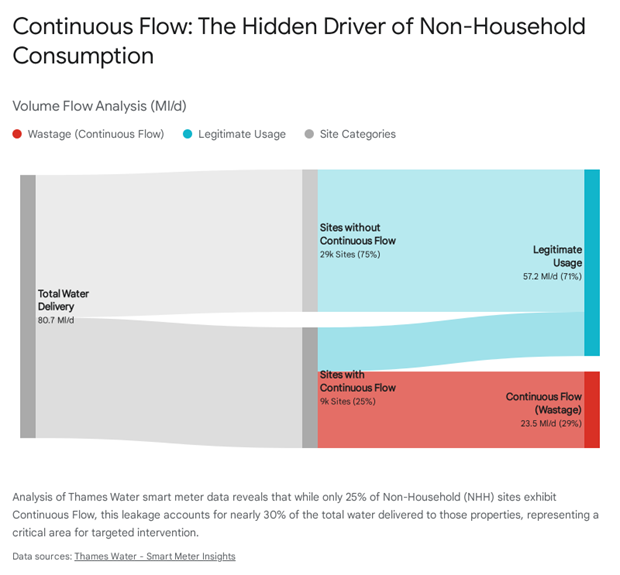
This is why the integration of Advanced Metering Infrastructure (AMI) with Active Automatic Flow Monitoring Shutoff (AAFMS) technology, as shown by solutions like Quensus LeakNet, is the pivotal to bridge that gap. By shifting from a passive notify and hope model to an active detect and isolate approach, the UK can address the continuous flow epidemic. Data from Thames Water suggests that 25% of smart-metered Non-Household (NHH) sites exhibit continuous flow, accounting for nearly 30% of their total consumption. Scale this to the national level reveals that a targeted deployment of smart valves on high-consumption assets could deliver a substantial portion of the required 9% reduction.
The 3 Billion Litre Challenge
The UK is operating under increasing water related stress. National data indicates that over 3 billion litres of water (equivalent to the daily water needs of over 20 million people), roughly 20% of the total public supply is lost to water leakage everyday! While water companies have historically focused on network leakage (mains and reservoirs), customer-side leakage (CSL) and internal wastage within the Non-Household (NHH) market represent a significant and under-addressed component of this loss.
Much of this leakage is not underground bursts on major mains, but the effect of thousands of smaller, persistent leaks within customer properties, it is what the industry calls "plumbing losses." These include leaking toilets, running urinals, and dripping taps, which when aggregated across the 1.2 million businesses in the NHH market, produces a massive drain on resources.
Defra's Reduction Targets
The pressure to reduce consumption is no longer economic or environmental, it has become statutory. The Environment Act 2021 and the subsequent Environmental Improvement Plan (EIP) 2023 have established a legal imperative for demand management. As mentioned previously, Defra has set a specific, legally binding target to reduce the use of public water supply in the non-household sector by 9% by 2037-38 and 15% by 2050 compared to the 2019-20 baseline.
The baseline year of 2019-20 saw total NHH consumption at approximately 2,718 million litres per day (Ml/d). A 9% reduction equates to removing roughly 247 Ml/d from the system, more than the entire daily supply of some smaller water companies. The challenge is compounded by population growth and the impacts of climate change, which are expected to reduce available water supplies by 10 to 15% by 2050. This creates a "jaws of death" scenario where supply lines fall while demand lines rise. Bridging this gap requires not just incremental improvements in efficiency but using technological interventions.
Emerging Demand Vectors: Hydrogen and Data Centres
The urgency of the 9% reduction target is further amplified by the emergence of new, water-intensive industries that were not significant factors in previous years. Two key sectors showcase this new pressure:
⚗️
The Hydrogen Economy
As the UK transitions towards net-zero, hydrogen is positioned as a key fuel source however the production of it is water intensive. Graeme from Fujitsu notes: "Hydrogen uses 10 litres of water to make 1kg of hydrogen." Scaling green hydrogen production via electrolysis could add an estimated 25 million litres per day (Ml/d) to national demand, directly eating into savings achieved elsewhere.
🖥️
Data Centres
These facilities require immense cooling capacity to manage the heat generated by servers. A medium-sized data centre can consume 1.3 Ml/day, which is equivalent to the daily domestic usage of approximately 11,000 people. With the increase of AI and cloud computing, the number of data centres is set to rise, creating localised hotspots of intense water demand that can stress regional networks.
The "jaws of death"
Climate change is expected to reduce available water supplies by 10 to 15% by 2050, while new industries drive demand upward. These emerging demands underscore the fact that "business as usual" efficiency is insufficient. We are not merely trying to reduce historic consumption, we are racing to create headroom for the industries of the future.
Market Dynamics
The NHH Market: Structure and Fracture
The Non-Household (NHH) market opened to competition in England in April 2017, allowing approximately 1.2 million businesses, charities, and public sector bodies to choose their water retailer. The idea was that the competition would drive innovation and efficiency, similar to the energy or telecoms markets, retailers would compete not just on price, but on value-added services like water efficiency.
However in the real world, the market has struggled to deliver these environmental outcomes. The separation of Wholesaler (the entity that owns the pipes, reservoirs, and water) and Retailer (the entity that bills the customer) has created a split incentive. Wholesalers face the Defra targets and the capital costs of new infrastructure (who have a strong incentive to reduce demand to avoid building new reservoirs). Retailers, operating on thin margins, often lack the capital to fund widespread efficiency retrofits. Their revenue model is also naturally linked to the volume of water sold.
Oli from Wave, a major retailer, notes the need for a "more competitive, thriving marketplace for efficiency," highlighting that surveys are costed and can be difficult to implement. He also argues for the implementation of private dataloggers over wholesale smart meters. Again showing the gap between the wholesalers an the retailers.
The 80/20 situation of Non-Household Water Consumption
The distribution of water usage in the NHH market is heavily skewed, a classic 80/20 situation. The path to the 9% target lies in targeting the vital few (where a percentage reduction translates to massive volumetric saving), not trying to engage every coffee shop and hair salon which would be inefficient.
1.6%
of customers (those using over 5 Ml/year)
account for 65% of total consumption
~50%
of all customers
consume less than 0.05 Ml/year — less than the average household
The 5,000 and 50,000 argument
There is a growing consensus that focusing on the top 50,000 NHH consumers, specifically targeting the 5,000 with the worst leakage profiles is the most viable path to the target. Analysis suggests that automating efficiency in just 12% of businesses could deliver the majority of required savings. Deploying active shutoff technology across 50,000 high-priority sites could reduce the market-wide continuous flow percentage from 30% to 15%, comfortably exceeding the 9% Defra target through technology deployment rather than behavioural change.
The Data Revolution
From 1.5 Million Reads a Year to 30 Million a Day
The Reduction Gap: Meeting the 9% Non-Household Target by 2038
BAU Forecast (Trend)Defra Target Path (-9%)Efficiency Gap
The trajectory required to meet Defra's 9% reduction target by 2037-38 diverges significantly from current consumption trends. The shaded area represents the Efficiency Gap that must be closed through active demand management technologies.
The water industry is undergoing a digital transformation, moving from legacy metering to Advanced Metering Infrastructure (AMI). Andrew Tucker from Thames Water captures the scale of this shift: "1.5 million reads per year 10 years ago to 30 million per day is game changing."
A meter used to be read once or twice a year for billing and that was it. It was impossible to know when water was used, only how much. With Advanced Metering Infrastructure (AMI), meters transmit data every 15 minutes or hour. This level of detail allows for the construction of a "load profile" for every building, revealing usage patterns that were previously invisible.
Thames Water has been a pioneer in this rollout, with a target of 100% smart metering by 2029-2035. Currently they have over 200,000 NHH meters, with approximately 40,000 (20%) being AMI and 9,500 (5%) being AMR (Automated Meter Reading).
Defining and Detecting Continuous Flow
The most critical insight from this high-frequency data is the identification of Continuous Flow (CF). Thames Water defines CF as a flow rate of over 1 litre per hour flowing for at least 14 consecutive days. For any non-household property, whether an office, school, or retail store, actual water usage should drop to near zero at some point during the day, typically at night or on weekends. If the flow never hits zero over a two-week period, it is a near-certain indicator of a leak or wastage.
Leaky Loos
Silent Toilet Leaks
The valve fails to close, allowing water to trickle continuously into the pan. Invisible to occupants and undetectable without continuous flow monitoring.
Urinals
Uncontrolled Flushing
Older urinal systems without passive infrared (PIR) controls flush automatically 24 hours a day regardless of occupancy. A entirely preventable source of waste.
Passing Valves
Stopcocks That Will Not Seal
Isolation valves and stopcocks that fail to fully close, allowing a constant trickle. Common in older commercial plumbing and frequently overlooked during routine maintenance.
The Scale of the Continuous Flow Epidemic
The data from Thames Water's smart meter estate provides a representative sample of the wider market;
● In a sample of 73,000 NHH sites, 23.5% were found to have continuous flow.
● In a focused analysis of 38,000 AMI meters, 9,000 sites (approx 25%) showed continuous flow. The cumulative water loss from these 9,000 sites was 23.5 Ml/day.
● Most critically, this continuous flow accounts for 30% of the total water delivered to these sites
This shows that a quarter of businesses, nearly a third of their water bill is effectively money flushed down the drain. Andrew Tucker urges the industry to "solve the easy stuff first", identifying leaking toilets and urinals as the primary targets. If automatic shutoff technology could reduce this 30% wastage figure down to 15%, it is a massive saving for the national level alone.
The Action Gap
Why Passive Metering Fails
The Limits of Notify and Hope
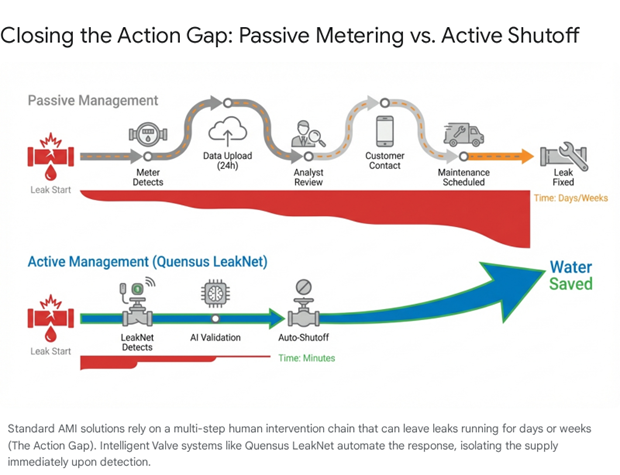
While AMI provides the data to see a leak, it does not provide the mechanism to fix it. The current industry standard response to detecting Continuous Flow is the utility or retailer sending a letter to the customer informing them of the likely leak and urging them to repair it.
Thames Water Trial
4,000 businesses with confirmed continuous flow were sent letters urging them to repair the leak. A control group of un-lettered businesses was also monitored over the same period.
Lettered Group
46%
reduced their continuous flow
Saved 37% of total CF volume
Un-lettered Control Group
39%
reduced their CF anyway
Saved 18% of CF volume
,More than half of the businesses sent a letter did nothing
The reasons are consistent across the market: a shop manager may not know what continuous flow means or how to check a urinal cistern. In leased properties, the tenant pays the bill but the landlord is responsible for plumbing repairs. And for most businesses, water bills represent a tiny fraction of operating costs, there is simply no urgency to act.
The Case for Active Intervention
The Action Gap, the stage between knowing about a leak and fixing it, is where the current strategy is failing. Passive metering provides visibility, but relies on human behaviour change which is slow, unreliable, and difficult to sustain.
To close the gap, the industry must move from Passive Detection (AMI) to Active Intervention (AAFMS). This means deploying technology that not only detects the leak but has the physical capability to stop it. This is the domain of smart valves and intelligent flow control systems like Quensus LeakNet.
If a customer ignores a letter about a leak, the leak continues. If a smart valve detects a leak and automatically shuts off the water, the leak stops. The customer has to address the issue to restore supply, or the system can manage the supply to allow actual use while preventing the waste (e.g., shutting off only at night).
The Technology
Intelligent Flow Control: How LeakNet Works
Quensus LeakNet: Anatomy of a Smart Valve
Quensus LeakNet represents the current standard in Active Automatic Flow Monitoring Shutoff (AAFMS) technology. Unlike residential leak detectors which are often simple moisture sensors on the floor, commercial-grade solutions like LeakNet are flow-based and integrated into the plumbing infrastructure. The core components:
📡
Flow Meter / Sensor
A high-precision turbine or ultrasonic meter capable of detecting low flows (down to 1 litre/hour)
🔧
Motorised Valve
An industrial-grade ball valve that hysically isolates the water supply. Sizes up to 8 inches (200mm) handle heavy commercial flow in hospitals, factories, and hotels.
🤖
Controller Unit
The brain of the system, containing the AI algorithms and connectivity modules. Uses Wi-Fi or cellular networks and supports CoAP (Constrained Application Protocol) for efficient connected device communication.
📴
Offline Resilience
Flow algorithms and shutoff logic are stored locally on the device. If the Wi-Fi goes down, the protection remains fully active. This is a critical differentiator from cloud-only systems where a loss of internet connection leaves the building vulnerable.
AI Profiling and Machine Learning
The smart element comes from the system's ability to learn. A commercial building has a complex water footprint that a simple fixed threshold would disrupt. LeakNet employs Machine Learning to build a Normal Usage Profile for the specific site.
AI Profiling: Learning Your Building
A commercial building has a complex water footprint. A hotel has high morning usage. A factory may have periodic spikes for process water. A fixed threshold would disrupt legitimate operations. LeakNet learns instead.
T
Temporal Zoning
The system understands that flow at 14:00 on a Tuesday is normal, but flow at 14:00 on a Sunday is not. Usage patterns are built up per site, per day, per hour.
A
Adaptive Thresholds
Dynamic alarm thresholds are set for Volume, Time, and Flow Rate. If consumption breaches the learned parameters, the system triggers an alert or initiates shutoff. 2-stage alerts (Remote Alert before Shutoff), the system minimises the risk of cutting off water during a legitimate but unusual event (e.g., late-night cleaning)
B
BMS Integration
LeakNet integrates with Building Management Systems via physical outputs (relays) or API. This enables Fire Alarm Override ensuring water remains available for sprinkler systems (if connected to the mains) or to prevent valves from closing on fire suppression loops if the fire alarm triggers. And Occupancy Control, linking with security systems to shut off supply when the building is armed/empty.
Strategic Interventions
6. The 5,000 Argument: Targeting the Vital Few
The Case for Targeted Deployment
The path to the 9% target lies in targeting the vital few Non-Households (NHH).
50,000
Top NHH consumers
AAFMS deployment targeting the top 5,000 to 50,000 consumers with active shutoff technology is the most efficient path to the Defra target.
12%
of businesses need intervention
Automating efficiency in just 12% of businesses could deliver the bulk of the required savings without requiring behavioural change from the other 88%.
The virtual barrier argument
Instead of trying to force 1.2 million small businesses to change their behaviour, regulators and wholesalers should focus incentives and mandates on the top 12%. If AAFMS were deployed across 50,000 high-priority sites, creating a virtual barrier against continuous flow, the reduction in leakage could bring the market-wide CF percentage down from 30% to 15%. This would comfortably exceed the 9% Defra target, effectively solving the regulatory challenge through technology deployment rather than behavioural engineering.
Economic Viability and ROI
The economic case for smart valves is robust, particularly for larger users.
💧
The Cost of a Leak
A leak of 1 m³ per hour costs approximately £70 per day, or £25,000 per year. A continuous flow problem running undetected for three months represents over £6,000 in wasted spend before anyone knows about it.
⚙️
Device Cost
A commercial smart valve system costs between £1,000 and £5,000 depending on pipe size. For a site with even a moderate leak, the payback period is typically measured in weeks, not years.
💰
Funding and Rebates
The UK Water Efficiency Fund and retailer incentive schemes are beginning to mobilise funding for smart valve retrofits (outside of the UK are offering up to 30 cents per litre saved per day for industrial customers). Installations that support BREEAM WAT 03 compliance can also attract additional credits, further strengthening the business case.
Real Results
LeakNet in the Field
Commercial Offices - BSS Head Office, East Midlands
Hidden leak found. Bill cut 12%. £50,000 damage avoided.
12%Annual bill reduction
£1,300Saved per year
£50kDamage prevented
• Challenge: Hidden leak not severe enough to cause flooding but significant enough to inflate bills.• Solution: LeakNet continuous monitoring identified the fault and later prevented a potential burst pipe, showing the dual value of bill reduction and risk mitigation.
26% consumption reduction across 400 point-of-use facilities.
26%Consumption reduction
1.7TCO2 saved per year
<1yrFull payback
• Challenge: 400 point-of-use facilities serving millions of passengers, manual checking impossible at scale.• Solution: Quensus LeakNet deployed across the estate for continuous monitoring and automated response.
9,000 litres per day silent loss caught before a school holiday.
9,000LLost per day
60 studentsDaily usage equivalent
• Challenge: Schools are vacant for long periods, a Friday evening leak can run 60 hours before Monday detection.• Solution: Two failed valves causing a silent 9,000 litre per day loss were captured immediately, preventing the loss running through a holiday period.
The 9% reduction achieved by efficiency must outpace the new demand from hydrogen and data centres.
● Hydrogen: With 10L of water needed for 1kg of hydrogen, a future hydrogen economy could add 25 Ml/d to demand. Smart metering will be essential to track this industrial usage and ensure it is as efficient as possible (e.g., closed-loop recycling).
● Data Centres: A single facility using 1.3 Ml/d represents a massive concentration of demand. Smart valves here are critical not just for efficiency, but for resilience, protecting the expensive servers from cooling loop leaks.
The Business Case: Anatomy of ROI for Intelligent Water Management
Total Value Stack
Operational Efficiency and BREEAMRisk MitigationDirect Savings
Direct Savings
Water Bill Reduction
Risk and Insurance
Avoided Excess and Premiums
Operational Efficiency
BREEAM WAT03 Credits and ESG
Payback Period
< 1 Year
Heathrow Airport case study
The return on investment for smart valve installation extends beyond direct water bill reductions. Insurance premium savings, risk mitigation (avoided excess), and operational efficiency (reduced manual checks) significantly enhance the financial case.
The Split Incentive Challenge in Facilities Management
A major structural barrier to fixing leaks in the NHH market is the complex web of liability known as the split incentive. In many commercial properties, the entity paying the water bill (the tenant) is different from the entity responsible for the infrastructure (the landlord), and often different again from the entity managing the site (the Facilities Management or FM company).
FM companies operate under Service Level Agreements (SLAs) which typically prioritise occupant comfort, safety, and uptime. A leaking urinal or a 24/7 continuous flow does not breach these standard SLAs, it does not stop the building from functioning, nor does it pose an immediate safety risk.
🏢
The Landlord
Responsible for the plumbing infrastructure but does not pay the water bill. No direct financial incentive to fund efficiency upgrades that reduce costs for their tenant.
🏪
The Tenant
Pays the water bill but has no authority over the building's plumbing. Cannot mandate repairs to infrastructure they do not own.
🔧
The FM Company
Manages the site but operates under Service Level Agreements (SLAs) that prioritise occupant comfort, safety, and uptime. A leaking urinal or 24/7 continuous flow does not breach a standard SLA. The cost of the fix comes from the FM budget, while the savings go to the tenant's utility bill. There is no contractual imperative to act.
The operational responsibility void
This creates an "operational responsibility void" where efficiency falls through the cracks of contractual obligations. The leak has been identified but nobody is required to fix it.
Three Practical Solutions
There are three practical mechanisms that can resolve this:
🚿
PIR and Switch-Based Controls
While smart valves like LeakNet offer sophisticated AI profiling and leak prevention, there is a compelling case for integrating simpler automatic shut-off technologies such as Passive Infrared (PIR) sensors can control water supply to washrooms based purely on occupancy.
Function: When a washroom is empty for a set period (e.g., 15 minutes), a solenoid valve on the supply pipe closes automatically.
Benefit: This creates a physical hard stop to water waste during nights and weekends without requiring complex data analysis.
SLA Integration: Unlike a reactive leak fix, maintenance of these valves can be written into FM contracts as a standard Planned Preventative Maintenance (PPM) task, similar to checking fire alarms.
🏆
BREEAM and ESG Compliance
Automated valves aligns with sustainability certifications. BREEAM Wat 03 credits are awarded for leak detection systems and flow control devices that regulate water supply to WC areas to reduce wastage. By framing the installation of these valves as a compliance requirement for BREEAM or ESG targets Converting a discretionary upgrade into a contractual obligation the FM provider must manage.
📄
Green Leases
The industry is moving towards "Green Leases" which are lease agreements with specific clauses that align the financial incentives of landlords and tenants towards sustainability.
Data Sharing Clauses: Mandating that tenants share water meter data with landlords (and vice versa) to identify waste.
Cost Recovery: Allowing landlords to recoup the capital cost of efficiency upgrades (like smart valves) from the tenant through the service charge, provided the tenant saves money on bills, solving the split incentive.
Automatic Shut-off Mandates: Clauses can explicitly require systems that "auto shut off or ramp down when not in use," making water isolation a contractual standard rather than an optional efficiency measure.
The result
By embedding auto-off technology into the legal framework of the lease and the operational framework of the SLA, the sector can ensure that water efficiency is not left to the goodwill of a facilities manager but is the operational standard of the building.
The Path Forward
The Roadmap Ahead
The 9% non-household water reduction target set by Defra for 2038 is achievable, but it will not be met by the current projection of passive metering and behavioural encouragement. The Continuous Flow crisis represents both a failure of current infrastructure and a massive opportunity for technological remediation.
Smart metering has successfully highlighted the problem, transforming the data landscape from 1.5 million reads a year to 30 million reads a day. However, the Action Gap remains, with less than half of businesses fixing leaks even when directly notified. The path forward requires a strategic pivot to Active Automatic Flow Monitoring Shutoff (AAFMS). By automating the fix, systems like Quensus LeakNet bypasses the human behaviour, delivering immediate and sustained savings. The strategy must be targeted focusing on the vital few, the top 5,000 to 50,000 consumers to deliver the bulk of the required 9% reduction.
1
Mandate Smart Valves for High Users
Update regulations to require Active Automatic Flow Monitoring Shutoff (AAFMS) for all NHH sites consuming over 5 Ml per year. Targeting this tier delivers disproportionate results, these are the sites where a percentage reduction translates to massive volumetric savings.
2
Harmonise Data Standards
Resolve the conflict between private dataloggers and wholesale smart meters by establishing open data standards that allow both to feed into wholesaler networks without friction or duplication. The data revolution has happened, the infrastructure to act on that data must follow.
3
Leverage Insurance and Green Leases
Formalise the link between water efficiency and risk management. Use green leases to bridge the split incentive gap and mandate automatic shutoff capabilities as standard in FM service level agreements, making water isolation a contractual requirement, not a discretionary upgrade.
4
Target the Easy Wins First
As Andrew Tucker from Thames Water puts it: "solve the easy stuff first." Launch targeted national action on leaking toilets and uncontrolled urinals, backed by automated detection technology and funding for smart valve retrofits across the highest-priority sites.
The bottom line
Data without control is noise
Smart metering has transformed the data landscape from 1.5 million reads a year to 30 million reads a day. But visibility is not a solution. The Action Gap remains stubbornly wide, with less than half of businesses fixing leaks even when directly notified. The 9% Defra target will not be met by counting litre, it will be met by controlling them. The technology exists, the urgency is statutory, the time for active intervention is now.
Latest News & Articles
Discover the latest at Quensus through our articles, showcasing community initiatives, exciting sponsorships, company updates and more!

.jpg)