

Leak detection technology has been widely used across commercial buildings, data centres, plant rooms and critical infrastructure for many years. Leak cables, in particular, provide a simple way to monitor areas where water ingress could cause significant disruption. However, traditional systems often rely on fixed alert thresholds that do not reflect real-world environmental variability.
At Quensus, ongoing engineering work is focused on improving how these signals are interpreted so that alerts are more meaningful, more reliable and ultimately more useful for proactive risk management.
Understanding How Leak Cables Work
Leak detection cables typically provide a numerical value representing moisture exposure, usually on a scale between 0 and 5000. In ideal dry conditions, a cable installed correctly in a non-condensing environment and isolated from conductive surfaces will usually return a very low baseline reading, often somewhere between 3 and 10.
When water is present, readings increase rapidly. Even minor leaks can push values above 100, while larger incidents generate significantly higher readings.
Most conventional monitoring panels use a simple fixed threshold, commonly around 50. Once that threshold is exceeded, an alert is triggered.
On paper, this seems straightforward. In practice, it is rarely that simple.
The Challenge: Environmental Variability and False Alerts
Real-world installations are influenced by many factors beyond actual leaks. These can include:
- Temperature fluctuations throughout the day
- Humidity changes and condensation cycles
- Proximity to metal surfaces or building materials
- Electrical interference
- Installation conditions or ageing infrastructure
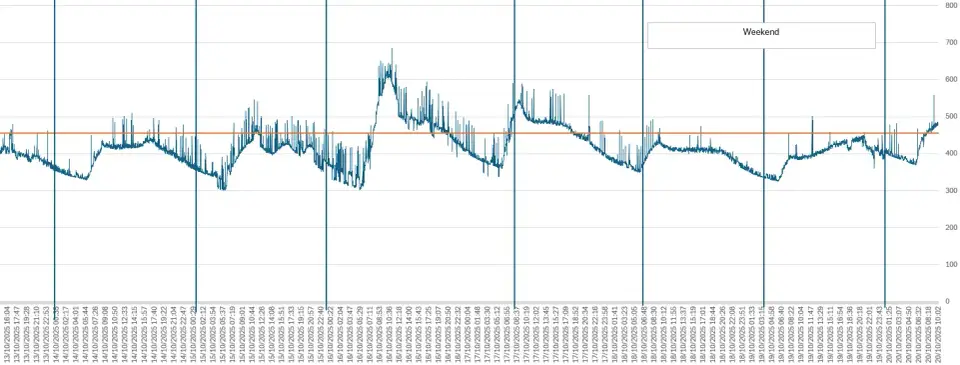
This often results in natural variation in leak cable readings. Fixed alert thresholds can therefore generate frequent false positives, which over time can reduce trust in monitoring systems and create unnecessary operational noise.
Facilities teams may begin ignoring alerts, which undermines the entire purpose of monitoring.
A Smarter Approach: Filtered Average Baseline Analysis
To address this, our engineering team has been developing a more adaptive approach to signal interpretation using what we call a Filtered Average Baseline.
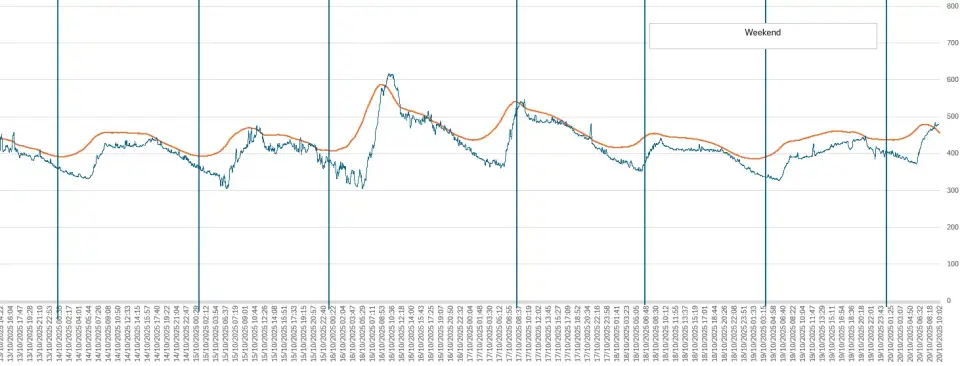
Rather than relying on a static threshold, the system continuously analyses historical readings to establish a dynamic baseline that reflects normal environmental behaviour. The algorithm then adjusts alert sensitivity relative to this evolving baseline.
This allows the platform to:
- Smooth out natural signal noise
- Track gradual environmental shifts
- Identify true anomalies more accurately
- Reduce unnecessary alerts
Initial testing indicates this approach can reduce false alerts by up to two orders of magnitude while still maintaining sensitivity to genuine leak events.
Why This Matters for Prevention, Not Just Detection
Reducing false alerts is not simply about convenience. It directly supports proactive water risk management.
Reliable signals mean:
- Faster response to genuine issues
- Greater confidence in automated intervention
- Better operational decision making
- Reduced alert fatigue for facilities teams
Most importantly, accurate data supports prevention strategies. When systems can reliably distinguish between environmental noise and genuine risk, automated controls such as shut-off valves can act with greater confidence.
This shifts water management from reactive investigation towards true preventative protection.
Continuous Engineering Development
This work forms part of broader ongoing engineering improvements across the Quensus platform. As connected building infrastructure becomes more sophisticated, the focus is increasingly on intelligent interpretation of data rather than simply collecting it.
Advanced analytics, adaptive thresholds and behavioural modelling are becoming essential components of modern risk mitigation systems, particularly where water damage represents a significant operational and financial exposure.
Looking Ahead
Leak cable intelligence is just one example of how smarter analytics can improve infrastructure resilience. As we continue refining algorithms and analysing real-world performance data, further enhancements are planned to improve accuracy, automation and preventative capability across connected building systems.
If you would like to learn more about the Quensus product line, make an enquiry today.